
Fear Paralysis Reflex (FPR)
Role: The Fear Paralysis Reflex is an early whole-body withdrawal and freeze response to perceived threat, emerging in utero and ideally integrating before birth. It represents instinctive inhibition of movement and breathing, with heightened autonomic arousal when safety is uncertain or when the “Startle” overwhelms thalamic processing.
Integration: Ideally integrates in utero or soon after (merging into the Moro reflex).
Corresponds to:
- Large Intestine (Arm Yang Ming) and Stomach (Leg Yang Ming) Sinew Channels. Myofascial Trains: Deep Front Line (DBL) and Superficial Front Line (SBL)
- Small Intestine (Arm Tai Yang) and Urinary Bladder (Leg Tai Yang) Sinew Channels. Myofascial Trains: Deep Back Line (DBL) and Superficial Back Line (SBL)
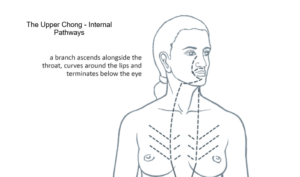 Chong Mai – Dai MAi: Master/couple points ineffective. Work directly on the channel, specifically, the internal pathways. Also, all points that intersect with the retinaculum can be considered part of the Dai Mai. Myofascial Trains: Spiral Line and Lateral Lines together
- UB – Kidney Channel with through and through technique: specifically, Upper Chong and intercostals
- Ren Mai (Conception Vessel) and Du Mai (Governing Vessel) – Through and through technique
Bracing patterns for palpation:
- Seated through-and-through tissue work: between the upper Kidney channel and the Urinary Bladder channel posteriorly
- Upper Chong: looking for extreme spasticity Ren 22 through Ren 15, specifically T1 through T3 in teh 1,2,3 intercostals.
- Brachial plexus: anterior aspects and the anterior axilla region
- Pectoralis minor: spasticity and retraction from Ren 18 across to the axilla, including Lung 1 and Lung 2
- Teres minor: posterior aspect of the axilla corresponding to SI 9 and SI 10
- Stomach channel: specifically need to open ST 11, ST 12, and ST 13 to facilitate vagal tone through the clavicular triangle
- ST 13 into ST 14: if ST 14 and ST 15 are spastic, move to P 1
Clinical Pearls:
- Ren 18- Ren 22: Intercostals and spasticity through the upper kidney line
- Brachial plexus: DFAL/Lung Sinew Channel: Extreme spasticity from the Pectoralis minor (Lu 1, Lu 2) through the coracoid @ Li 15. Glue or rigidity @ Ps 2, P3, HT 1, and SI9 and the LI channel @ medial aspect of the humerus, extending down the radial aspect of the forearm to the thumb.
- Large Intestine (LI) Channel: Tension along the radial border (Yang Ming) corresponding to the internal rotation of the arm. Retraction of the shoulder girdle and medial compression of the humerus, locking the brachial plexus.
Developmental/Sensory Deficits: Emotional hypersensitivity, sensory defensiveness (over-reacting to noise/light), low tolerance for change, and “freezing” when overwhelmed.
