
Polyvagal Theory is in the spotlight again. Same argument, same researcher, roughly every four or five years. Lather, rinse, repeat. Porges rebuts it each time, most recently in the same journal issue. The version of this debate that spread across social media was not the peer reviewed paper. It was a Substack post written by a science journalist.
Yesterday a doctor in the Netherlands took umbrage with my trademarked business name. He had decided polyvagal theory had been debunked. So he scrolled through months of my posts, flagged every single one that included my trademark and brand name as false content, and LinkedIn removed them overnight with no appeal, no warning, and no due process.
I walked into medicine expecting collaboration. I imagined clinicians curious about each other’s work, building something together. What I found instead was a hotbed of undiagnosed personality disorders, trauma, combativeness, and a deep need to invalidate others. Instead of asking where does this fit into the schema and where might these intersect, the default move is invalidation.
The entire thing is a rap battle and it always has been. The moment I saw it I flashed straight to Hamilton and the founding fathers.
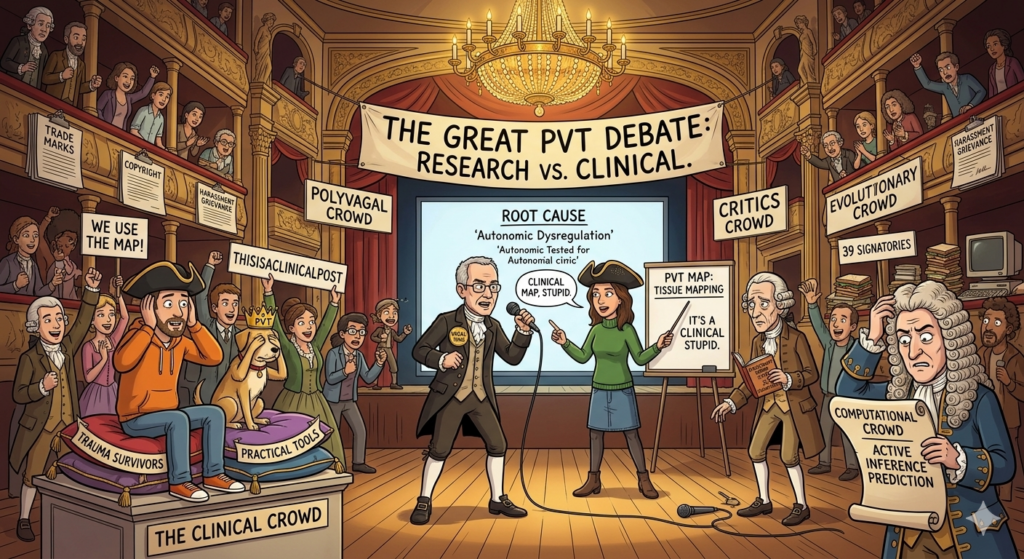
Cabinet Meeting Number One. Ladies and gentlemen, you could have been anywhere in medicine tonight. The issue on the table: polyvagal theory. One point of order before we begin. The term polyvagal is descriptive. It describes the trajectory of the vagus nerve. You do not have to accept the theory to use the map. And if the name bothers you that much, take a deep ventral breath and take a walk.
Burr saw the same thing in 1804. They smear each other in the press and “don’t print retractions.” This is medicine in 2026 and nothing has changed. The researchers who cannot tolerate a clinical framework they did not build are not serving science. They are serving their own intolerance.
There is a big difference between evolutionary neuroscience, computational neuroscience, research neuroscience, and clinical neuroscience. They are not the same animal. The critics are predominantly neurophysiologists, evolutionary biologists, and autonomic scientists. As far as I can tell none of them are working clinically with dysautonomia patients. And not one of them has offered anything to replace the framework they want to dismantle. Big pharma funds a reductionist hunt for one drug target. Neuroscience will never yield to that. Too many pathways, too many interactions between brain and body, and a regulated nervous system has no patent. People are dying while they argue over where the electron goes and who gets the credit.
From my own perspective, every one of them is correct. Friston is right that the brain predicts. Porges mapped the vagal hierarchy. Van der Kolk battled for developmental trauma disorder for thirty years when no institution would touch it. Grossman’s HRV argument has merit. Myers gave us the fascial map. Barral and the osteopaths gave us the hands to work it and provided the care and feeding of the fascial system that makes the clinical work possible. Hikosaka’s work on the lateral habenula explained what happens in high arousal states, the brake on dopamine that fires before the reward circuit can complete. Each one added a real piece of the neuroscience. Each one advanced my own journey through neuroplasticity and into the midbrain and brainstem. None of them has the whole picture. And instead of building one map together they circle and attack.
Friston’s predictive coding framework is real and useful. But the argument ignores the 80% afferent vagus that carries the body’s signal up to inform the prediction in the first place. The body is not downstream of the brain. It is the input. That is not a theoretical disagreement. That is the difference between what happens in a test tube and what sits in a treatment room. The vestibular system alone blows a hole in the pure prediction model. The brain and the tissue that houses it are indivisible. Friston’s framework still thinks in Cartesian terms. The body does not.
Grossman’s HRV argument has merit. I agree that HRV is not a diagnostic indicator in severe dysautonomia. It is a symptom and the pulse changes too much to be reliable. I have published on this. I will have my own row to hoe within the TCM community as we get these ideas into the collective. The pulse is not a diagnostic indicator in PVA, and that may come as a surprise for my colleagues who trust the method they were taught.
I chose ‘polyvagal acupuncture’ to set it apart from the other branches of TCM (zangfu, trigger point, kiiko style, battlefield, and Japanese style), to signal a deeper level of neuroscience and neuroplasticity training than we have in the current acupuncture curriculum. The pulse is one symptom, but the sinew channel is the tapestry, where signal meets soma.
A surgeon I worked with told me something I have never forgotten. We were doing a mixed consult, and I asked if he could take on a complex case. He said no, that it had to go to his partner. When I asked why, he said he could take out the organ if it was sick, he couldn’t nurse it like a sick pup. When I asked if medicine was really that compartmentalized, he said yes. And then he told me that if the general public ever heard what grand rounds actually sounds like, the name calling, the F bombs, the territorial warfare over ideas, they would be horrified. There is no medical fact. There is only medical opinion.
The cabinet meeting never ends. But our patients with DTD, PTSD, Long COVID, neurogenic decline, and dementia don’t have time for these squabbles. Neither did I. Neither do you.
Thanks to Lin-Manuel for the imagery…
