
© 2025 J. Moffitt. Registered U.S. Copyright Office. Polyvagal Acupuncture®.
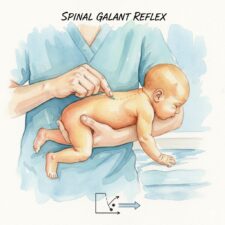
The Spinal Galant Reflex appears around 20 weeks of gestation and typically integrates by 9 months of age. This reflex is triggered when the skin along the side of the infant’s back is stroked, causing the infant to curve their body towards the stimulated side. The Spinal Galant Reflex plays a crucial role in the development of trunk coordination and flexibility, which are important for crawling and other early movements. Additionally, this reflex is thought to assist in the birthing process by helping the baby to navigate through the birth canal.
The Galant reflex is essential for initiating rolling, freeing the pelvis from the thoracic cage, AND Stimulating the bladder and bowel during birth and infancy.
However, when retained, it becomes a persistent postural and sensory irritant, often linked to hyperactivity, poor core tone, and sacral bracing. Moreover, the presence of this reflex may lead to difficulties with coordination and balance, as the trunk muscles are unable to fully support stable movement. This can affect activities that require smooth, coordinated movements, such as walking, running, or dancing, and may contribute to chronic lower back pain.
- Appears: Birth
- Integrated by: 3-9 months
- Muscles Involved: Spinal muscles, Hip muscles, Abdominals, Gluteal muscles
- Extraordinary Meridians: Dai
- The Dai channel encircles the waist and affects the lateral trunk muscles involved in the side-bending movement of the Spinal Galant Reflex.
- Myofascial Line: Lateral Line (LL)
- Common Diagnoses: ADHD, learning disabilities
If the Spinal Galant Reflex remains unintegrated or becomes reactivated in adulthood, it can lead to several challenges. Adults with an unintegrated Spinal Galant Reflex may experience increased sensitivity along the lower back, leading to discomfort when wearing tight clothing or belts. This heightened sensitivity can also make it difficult to sit still for extended periods, as even minor stimuli may trigger involuntary movements or fidgeting. In some cases, an unintegrated reflex can contribute to postural issues, such as scoliosis, because its continued activation can lead to asymmetrical muscle development and spinal alignment problems.
Signs of Retention/Impact on ADLs:
- Postural issues like scoliosis and pelvic misalignment
- Lower back pain
- Bedwetting, stress incontinence
- Hyperactivity
- Attention and concentration difficulties
- Chronic digestive issues
- Lower body coordination problems
Sinew Channels:
o Gallbladder sinew channel — Lateral Line (LL) (lateral spinal movement and dynamic side-to-side fascial tension)
o Dai Mai (belt channel) — transverse stabilizer, anchors trunk to pelvis, coordinates rotation
o Lateral Line (LL) — integrates muscular and fascial responses along the side body, supports vestibular balance
o Spiral Line (SL) — facilitates rotational and torsional movement, maintains fascial continuity and balance
Neurological and Autonomic Profile
Spinal Galant is spinal in origin, involving:
- Tactile receptors along L1–S2 dermatomes
- Ipsilateral spinal motor neurons for hip flexion
- Interneuronal circuits connecting to the bladder, bowel, and pelvic floor
It is highly autonomically active, particularly in:
- Parasympathetic sacral outflow
- Sympathetic spillover in lumbosacral ganglia
When unintegrated, it contributes to sacral dysregulation, increased urination urgency, poor pelvic stability, and hyperarousal in response to lateral touch or pressure.
Functional Role and Reflex Hierarchy
Spinal Galant supports:
- Pelvic release from thoracolumbar stiffness
- Segmental spinal control for rolling and crawling
- Pelvic mobility in quadruped and gait
- Stimulus–response mapping along the lumbar spine
It interacts directly with:
- Moro (global startle)
- TLR (spinal flexion/extension)
- STNR (upper/lower body segmentation)
- Toilet training circuits via sacral parasympathetics
Failure to integrate Galant creates conflicting spinal tone and poor pelvic tracking, especially during trunk rotation or lateral weight shift.
Clinical Presentation of Retained Galant
- Inability to sit still with back support
- Over-response to touch on the lower back
- Sacral tension or “duck butt” postures
- Bedwetting past the appropriate age
- Pelvic torsion and poor sacroiliac stability
- Twisting gait or constant need for motion
In manual or movement therapies, Galant often shows as:
- Reflexive arching or pelvic rotation during lumbar contact
- Hip hike or escape pattern on lateral touch
- Difficulty with bilateral pelvic loading in gait or squatting
Somatic and Energetic Architecture
Spinal Galant disrupts core-limb coordination, especially through the lateral and spiral fascial systems. It prevents the sacrum from integrating with trunk movement, resulting in dissociation or fixed rotation of the pelvis.
Muscles Involved:
- Quadratus lumborum
- Iliocostalis and multifidi
- Gluteus medius and minimus
- Piriformis and lateral rotators
- Pelvic floor and adductors (compensatory bracing)
Cranial and Autonomic Structures:
- Sacral parasympathetics (S2–S4)
- Lumbosacral sympathetic chain
- CN X (indirectly via pelvic vagal tone)
Myofascial Lines:
- Lateral Line
- Spiral Line
- Deep connections to DFL and pelvic floor sheaths
Acupuncture Zones and Meridians:
- Bladder and Gallbladder channels: lateral fascial bracing
- Dai Mai: transverse pelvic rotation
- Ren3, GB30, UB26, UB28, UB53–UB54, GB41, LIV8
Energetic Interpretation
From a TCM perspective, retained Spinal Galant creates lateral energetic leakage and loss of Dai Mai containment. It prevents full engagement of:
- Kidney–Bladder axis for core–pelvis grounding
- Liver–Gallbladder pivot for rotation and spatial orientation
Energetically, this reflex splits the body’s midline through the sacrum, leading to:
- Inability to settle the lower dantian
- Premature ejaculation or incontinence in adults
- Restlessness and pelvic fidgeting
- Chronic sacral ache or “energy leak” in the lumbar basin
Summary Table
| Feature | Spinal Galant Reflex |
| Appears | ~20 weeks gestation |
| Integrated by | ~9 months |
| Primary Movement | Lateral hip rotation in response to paraspinal stimulation |
| Neuroanatomy | L1–S2 dermatomes; spinal interneurons; sacral autonomics |
| ANS Effect | High; pelvic floor and bladder involvement |
| Fascial Pattern | Lateral line, spiral rotation, sacral disorganization |
| TCM Systems | UB, GB, Dai Mai, Ren3 |
| Clinical Red Flags | Bedwetting, sacral rigidity, fidgeting, poor pelvic anchoring |
