© 2026 J. Moffitt. Registered U.S. Copyright Office. Polyvagal Acupuncture®.
Early TCM practitioners wrote from direct observation, using language shaped by the natural world of their era. Having studied for many years with great teachers like Miki Shima, Kiko Sensei, Masakazu Ikeda Sensei, and Edward Obaidey Sensei, I was taught a vital distinction: to read the classics as conceptual frameworks, not literal instructions.
This perspective fundamentally changes how we interpret traditional texts. As Ikeda Sensei remarked, the classics, as written, should be considered “gossip,” and until we bring them to life through our experience and insight, TCM ideas remain conceptual.
The historical reluctance within TCM to redefine abstract, vague terms has trivialized this rich tradition, leaving it vulnerable to subjective interpretation and, at times, to what I’ve seen as “magical thinking” in the US. What does it mean, clinically, to harmonize the ying and the wei? Zhong Qi and Ying Qi sound similar; what are their differences, and what is their clinical relevance? How do we understand these concepts beyond theory?
To move from theory to clinical application, it helps to expand classical TCM ideas to include their modern scientific counterparts. Understanding how traditional medicine classifies these influences allows us to map their impact onto modern physiological models, particularly the autonomic nervous system (ANS). This clarifies the links between TCM theory and contemporary biomedical understanding, creating a more integrated clinical framework.
Seven External Factors (External Pathogenic Factors)
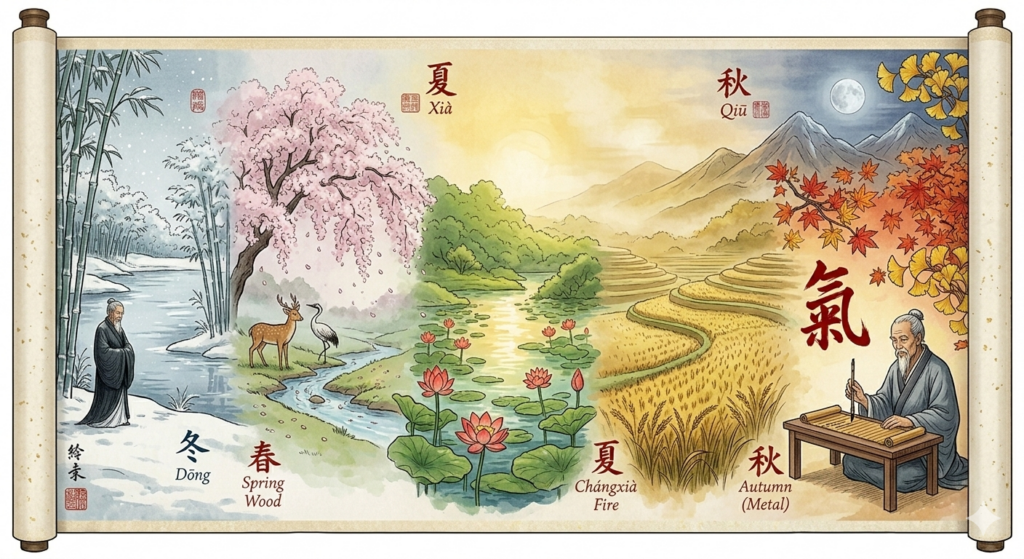 TCM lists external and internal factors that disrupt balance and interact with key physiological systems. These factors are often referred to as the “Six Evils” (六淫, Liù Yín), with an additional one, making it seven. They represent climatic or environmental conditions that can invade the body and cause illness when the body’s defenses are weak:
- Wind (风, Fēng)
- Cold (寒, Hán)
- Heat/Fire (火, Huǒ)
- Dampness (湿, Shī)
- Dryness (燥, Zào)
- Summer Heat (暑, Shǔ)
- Pestilence (疫, Yì): Regarding Pestilence (疫, Yì), we have this for the first time in almost a century-COVID. Most of us did not live through polio or typhus.
External factors trigger the body’s defensive responses through the sympathetic nervous system. In TCM, this outward, activating response is described as yang, regardless of whether the stimulus is heat or cold.
Internal Factors (Emotional Factors)
 Traditional Chinese Medicine defines internal factors as the Seven Emotions: joy, anger, worry, pensiveness, sadness or grief, fear, and fright. When emotions become excessive or suppressed, they disrupt internal harmony through the limbic system and can lead to illness. TCM treats these emotional influences as distinct from external or environmental factors.
- Joy (喜, Xǐ)
- Anger (怒, Nù)
- Worry (忧, Yōu)
- Pensiveness (思, Sī)
- Sadness/Grief (悲, Bēi)
- Fear (恐, Kǒng)
- Fright (惊, Jīng)
Ancient practitioners saw that emotions and environment could make people sick, but they explained this in broad, qualitative terms. Modern science shows that imagined or remembered stress, like rehashing an argument in the shower, triggers the same physiological stress response as the real event. This is what TCM recognized as the link between emotions and physical health, even before the discovery of the autonomic nervous system.
Novel or intense sensory inputs activate the sympathetic nervous system (Yang/+ charge) through the five senses. In TCM, wei qi is the body’s defensive energy, circulating at the surface to guard against threats. Modern neurophysiology shows that the sympathetic system initiates defensive responses, including muscle contraction, increased alertness, and redistribution of blood to the periphery when danger is perceived. Because defensive activity is governed by the sympathetic nervous system, wei qi, as a defensive force in TCM, is, by definition, under the control of the SANS.
By analogy, if wei qi reflects the body’s outward, defensive activity similar to the sympathetic nervous system, then ying qi, which nourishes and restores the body, aligns with the parasympathetic system. Ying qi circulates through the blood vessels, supporting growth, repair, and cellular nourishment. This shows how TCM’s restorative processes parallel those of parasympathetic activity, such as healing, digestion, and neuroplasticity.
In this context, the TCM principle of “harmonizing the Ying and Wei” becomes clinically meaningful. It describes restoring balance between sympathetic defense and parasympathetic nourishment, enabling patients to transition out of chronic survival states so the body can resume nourishment and repair.
The vagus nerve is central to the parasympathetic system, orchestrating the body’s shift from defense to rest. When there is no threat, the vagus sends signals through the brainstem and neck to prompt relaxation, deep breathing, and a return to a state of repair. This vagal response enables restoration and counters sympathetic arousal.
When survival responses become chronically activated, as trauma research by van der Kolk and Porges shows, the retained fight-or-flight response alters brain and body function. TCM’s pattern differentiation complements this by offering practical diagnostic patterns for autonomic dysfunction, which are clinically helpful for trauma, PTSD, and dysregulation patterns such as Long COVID. Integrating neurochemical insights from trauma science with TCM’s clinical frameworks enables us to move from theory to practice. This approach supports treatments that address both the neurobiology of the fight, flight, or freeze responses and the objective restoration of parasympathetic tone to promote neuroplasticity.
Correlation of Qi Types with Ganglionic Plexuses, Yin-Yang Aspects, and Western Correlates
In TCM, the various types of qi each have specific functions and locations in the body, which can be correlated to ganglionic plexuses and physiological functions in Western medicine. Qi types are categorized as yin or yang based on their roles. Examining overlaps between TCM and modern neurology enables expanded definitions relevant to both systems. This analysis also considers the effects of prolonged states of fight-flight-freeze. Ultimately, recognizing our integration with the autonomic nervous system (ANS) enhances our approach to treatment.
- Wei Qi (Defensive Qi)
TCM Function: Protects the body from external pathogens, circulates on the surface, particularly in the skin and muscles.
Western Correlate: Sympathetic Nervous System (SNS)
- Function: Mobilizes the body’s defenses against external threats, increases heart rate, blood flow to muscles, and alertness.
- Ganglionic Plexus: Sympathetic Chain Ganglia
- Location: Runs parallel to the vertebral column.
- Function: Controls the fight-or-flight response, regulating sweat glands and blood flow to the skin and muscles.
- Predominantly: Sympathetic
- Yin-Yang Aspect: Yang – Wei Qi is defensive in nature and involved in the body’s active response to external threats.
- Primitive Reflexes: All of them, FPR, CTG, Moro Reflex, Startle Reflex
- Function: Triggers defensive responses to sudden stimuli.
- Nerves: Sympathetic nerves, Spinal nerves
- Sustained Fight-Flight-Freeze Response: Hyperfunction – Wei Qi would likely become hyperactive, potentially leading to chronic inflammation, heightened immune responses, and excessive energy expenditure.
- Endocrine Function: Correlates with the activity of the adrenal glands, specifically the secretion of adrenaline and cortisol, which are crucial in the body’s fight-or-flight response.
- Zhong Qi (Central Qi or Gathering Qi)
TCM Function: Associated with the middle jiao (stomach and spleen), responsible for digestion and energy production.
Western Correlate: Parasympathetic Nervous System (PANS), the Enteric Nervous System, and Vagus Nerve
- Function: Supports digestion, rest, and repair processes; regulates heart rate, gastrointestinal motility, and inflammatory responses.
- Ganglionic Plexus: Celiac Plexus, splanchnic
- Location: Upper abdomen, around the celiac artery.
- Function: Innervates the stomach, spleen, liver, pancreas, and parts of the intestines, regulating digestive processes.
- Predominantly: Parasympathetic
- Yin-Yang Aspect: Yin – Zhong Qi is tied to rest, digestion, and energy production, supporting the body’s restorative functions.
- Primitive Reflexes: Rooting Reflex, Sucking Reflex
- Function: Stimulates feeding and digestion.
- Nerves: Vagus nerve (CN X), Splanchnic nerves
- Sustained Fight-Flight-Freeze Response: Hypofunction – With high cortisol Zhong Qi would be suppressed, leading to digestive issues, reduced nutrient absorption, and overall decreased energy production. IN extreme states (dosal Freeze) we move to cytoplasmic ATP and mitochondrial dysfunction.
- Endocrine Function: Correlates with the function of the pancreas (insulin and glucagon secretion) and gastrointestinal hormones (such as gastrin, secretin, and cholecystokinin), which regulate digestive processes and energy metabolism.
- Ying Qi (Nutritive Qi)
 TCM Function: Flows in the blood vessels and meridians, nourishes the organs, and supports growth and development.
Western Correlate: Circulatory System and Nutritional Absorption
- Function: Delivers nutrients and oxygen to cells, supports growth and development. GSM described this as the PANS smooth muscle patency that is inhibited in high arousal states.
- Plexus: Aortic Plexus, smooth muscle tissue in the vasculature
- Function: Influences the vascular system, supporting the circulation of blood and nutrients.
- Predominantly: Mixed, but with significant parasympathetic influence.
- Yin-Yang Aspect: Yin – Ying Qi nourishes and supports growth and development, contributing to the body’s maintenance and repair.
- Nerves: Vagus nerve (CN X), Peripheral nerves
- Sustained Fight-Flight-Freeze Response: Hypofunction – Cortisol inhibits Ying Qi – SANS suppresses away from nourishment and growth towards immediate survival, leading to malnutrition and impaired development.
- Endocrine Function: Correlates with anabolic hormones such as growth hormone (GH), thyroid hormones (T3 and T4), and insulin-like growth factors (IGFs), which facilitate nutrient utilization, cellular growth, and tissue repair.
- Yuan Qi (Original Qi or Source Qi)
TCM Function: Foundational energy stored in the kidneys, derived from congenital essence and nourished by postnatal qi.
Western Correlate: Genetic Blueprint and inherited Trauma; in TCM tied to Kidneys, DNA?
- Function: Fundamental energy source, akin to hormonal and genetic influences on growth and development.
- Ganglionic Plexus: Renal Plexus
- Location: Around the kidneys.
- Function: Innervates the kidneys and adrenal glands, regulating their function and influencing energy balance.
- Predominantly: Sympathetic
- Yin-Yang Aspect: Yin – Yuan Qi is tied to fundamental life processes, including growth, reproduction, and development.
- Nerves: Renal nerves, Splanchnic nerves
- Sustained Fight-Flight-Freeze Response: Hypofunction – Yuan Qi may be depleted over time, leading to adrenal fatigue, hormonal imbalances, and reduced overall vitality.
- Endocrine Function: Correlates with the function of gonadal hormones (estrogen, progesterone, and testosterone) and adrenal glands (aldosterone and cortisol), which are essential for growth, development, reproductive health, and overall vitality.
- Zong Qi (Pectoral Qi)
TCM Function: Gathers in the chest, supports respiration, and circulates blood.
Western Correlate: Respiratory and Circulatory Systems
- Function: Supports breathing and oxygenates blood.
- Ganglionic Plexus: Cardiac Plexus, Brachial plexus
- Location: Around the heart, pericardeum.
- Function: Innervates the heart and lungs, regulating heart rate and respiratory function. Inverse to Kidney.
- Predominantly: Mixed, but with significant sympathetic influence.
- Yin-Yang Aspect: Yang – Zong Qi is involved in active functions like respiration and circulation, which require dynamic energy.
- Primitive Reflexes: FPR, MORO
- Function: Supports respiration and coordination.
- Nerves: Vagus nerve (CN X), Phrenic nerve
- Sustained Fight-Flight-Freeze Response: Hyperfunction – Zong Qi may become overactive, leading to increased heart rate, hypertension, and respiratory issues. Retained FPR causes a lot of trouble.
- Endocrine Function: Correlates with the activity of the thyroid gland (thyroid hormones T3 and T4) and adrenal medulla (epinephrine and norepinephrine), which enhance respiratory and cardiovascular function, supporting the body’s dynamic energy needs. Thymus.
- Jing Qi (Essence Qi)
TCM Function: Stored in the kidneys, responsible for growth, reproduction, and development. It provides the “Marrow” and the foundational substrate for the brain and spinal cord.
Western Correlate: Genetic/Epigenetic Expression and Neural Regenerative Systems
Function: Influences growth, reproductive health, and the qualitative rate of neuroplasticity and systemic repair.
Ganglionic Plexus: Inferior Hypogastric Plexus
Location: Pelvic region.
Function: Innervates the reproductive organs and lower urinary tract, influencing reproductive health and development.
Predominantly: Mixed, but with significant parasympathetic influence.
Yin-Yang Aspect: Yin – Jing Qi supports procreation and growth, which are restorative and generative processes.
Nerves: Pudendal, Pelvic splanchnic nerves.
Sustained Fight-Flight-Freeze Response: Hypofunction/Inhibition – A retained FF response creates a “Resource Robbery” where Jing Qi is diverted from growth, marrow-filling, and neuro-regeneration toward immediate survival. This autonomic dysregulation acts as the primary barrier to neuroplasticity, leading to “brittle” neural states, reproductive issues, and developmental delays.
Endocrine Function: Correlates with the secretion of sex hormones (estrogen, progesterone, and testosterone), growth hormone (GH), and Neurotrophins (such as BDNF and NGF). These are critical for reproductive health, genetic expression, and the lifelong ability of the nervous system to re-wire and repair itself.
- Qi Hua (Transforming Qi)
TCM Function: Responsible for the transformation and movement of substances within the body, such as fluid metabolism.
Western Correlate: Metabolic Processes and Enzymatic Functions
- Function: Regulates metabolic processes and enzymatic transformations in the body.
- .Yin-Yang Aspect: Yin – Qi Hua is involved in the transformation and movement of substances within the body, essential for maintaining internal balance and repair.
- Primitive Reflexes: Babinski Reflex
- Function: Influences the movement and coordination of the lower body.
- Nerves: Vagus nerve (CN X), Enteric nervous system
- Hypofunction – Qi Hua may be impaired, leading to digestive and metabolic disorders and fluid imbalance.
- Endocrine Function: Correlates with metabolic hormones such as insulin, glucagon, thyroid hormones (T3 and T4), and cortisol, which regulate metabolism, fluid balance, and the body’s ability to transform and utilize nutrients.
Summary
These correlations between types of qi in TCM, specific ganglionic plexuses, Western medical functions, yin-yang aspects, primitive reflexes, nerves, and their hypothesized behaviors during sustained fight-flight-freeze responses demonstrate how ancient and modern medical systems can intersect. Understanding these relationships enhances application by integrating the strengths of both Eastern and Western perspectives.