
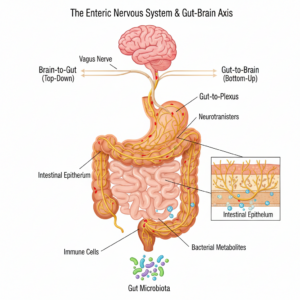
The Enteric Nervous System (ENS) is the most extensive and intricate part of the Autonomic Nervous System (ANS), consisting of approximately 400-600 million neurons. Present in two primary networks—the myenteric and submucosal plexuses—the human ENS begins its development during the gestational period and experiences its most active growth state peri-natally through the first year of life. (Waxenbaum JA, [Updated 2023 Jul 24])
The ENS receives both sympathetic and parasympathetic innervation and governs the entire digestive pathway, referred to in Traditional Chinese Medicine (TCM) as the production of postnatal Qi. This process starts with a series of ganglionic plexuses following the digestive tract from the trachea to the anus.
Parasympathetic innervation is crucial for maintaining the ENS, with the Sympathetic-Adrenal-Medullary (SAM) axis and stress hormones downregulating its function in response to external challenges. “Rest and digest,” repair, and other parasympathetic functions become inhibited under fight-flight-freeze patterns.
As a component of the ANS, the ENS functions autonomously and independently of the central nervous system (CNS), earning it the title “gut-brain.” (Waxenbaum JA, [Updated 2023 Jul 24])
The ANS communicates with the individual organs by way of ganglionic plexuses in each of the Zang (Yin) Organs. These plexuses become the basis for the Zang organ function, while the somatic nervous system supports the meridian relationships described in the classics.
Examples of the primary plexuses are below, but this is only a sample. A nerve plexus is a cluster of nerve centers with both sympathetic and parasympathetic nerve endings. The plexuses are myriad and include plexuses in all the Zang organs, as well as larger plexuses that represent the three jiaos. They are essential for maintaining homeostasis and facilitating numerous bodily functions.
Here are some instances of plexuses along with their alignment with Traditional Chinese Medicine (TCM) meridians, although this compilation is not complete.
Plexus | Governs | TCM Correspondence |
Cardiac Plexus | Controls the heart | Heart meridian |
Celiac Plexus (Solar Plexus) | Governs the spleen and stomach | Spleen/Pancreas/Stomach meridians |
Superior Mesenteric Plexus | Regulates the small intestine | Small Intestine meridian |
Inferior Mesenteric Plexus | Manages the large intestine | Large Intestine meridian |
Pulmonary Plexus | Manages the lungs | Lung meridian |
Esophageal Plexus | Manages the esophagus | Qiaos |
Hepatic Plexus | Controls the liver | Liver meridian |
Gastric Plexus (Ventral Vagal Trunk) | Governs the stomach | CHONG |
Expanding Traditional Chinese Medicine (TCM) theory to include modern neuroscience provides an opportunity to unveil the interconnectivity of the body’s systems.
In “Chinese Acupuncture,” George Soulié de Morant (GSM) characterizes the gallbladder, encompassing both the organ and channel, as embodying the entire biliary digestive process. This includes the bile duct, secondary hepatic recirculation, and Oddi’s sphincter (Soulié de Morant, 1994). Building on this idea, we can broaden our understanding of the Spleen’s functions of transformation and transportation to include not only its role in the pancreas’s secretion of insulin but also parasympathetic activity and digestion within the middle jiao. GSM describes the spleen-pancreas relationship as intrinsic and interconnected, similar to the biliary system.
Indeed, the lower command points on the leg yang Ming channel (ST 37, 38, 39-40) mirror the entire digestive process and waste elimination, reflecting the sympathetic aspects of digestion from the trachea to the anus. The Stomach channel and organ embody the complete sympathetic role in digestion. Furthermore, the tibial aponeurosis is indicative of vagal tone quality through the stomach, with many clients exhibiting not only complete spasticity but also adhered tissue to the tibialis anterior muscle.
📚 References
Almaas, A. H.(Representative work for Essential Presence and Inquiry.)
Almaas, A. H. (1998). The unfolding now: Realizing your essential power and freedom. Shambhala.
Brown, B. (2012). Daring greatly: How the courage to be vulnerable transforms the way we live, love, parent, and lead. Gotham Books.
Deadman, P., & Al-Khafaji, M. (2007). A manual of acupuncture (2nd ed.). Journal of Chinese Medicine Publications.
Fraser, J. (2020). The bullied brain: Heal your scars and restore your health. Independently published.
Jung, C. G. (1968). The collected works of C. G. Jung: Vol. 9, pt. 1. The archetypes and the collective unconscious (2nd ed.). (R. F. C. Hull, Trans.). Princeton University Press. (Original work published 1934–1951)
Kalsched, D. (1996). The inner world of trauma: Archetypal defenses of the personal spirit. Routledge.
Levine, P. A., & Frederick, A. (1997). Waking the tiger: healing trauma: the innate capacity to transform overwhelming experiences. North Atlantic Books.
Myers, T. W. (2020). Anatomy trains: Myofascial meridians for manual and movement therapists. Churchill Livingstone.
Porges, S. W. (2011). The polyvagal theory: Neurophysiological foundations of emotions, attachment, communication, and self-regulation. W. W. Norton & Company.
Soulié de Morant, G. (1939). L’Acupuncture Chinoise (Chinese Acupuncture). Éditions Payot.
Stecco, C. (2015). Functional atlas of the human fascial system. Churchill Livingstone.
van der Kolk, B. A. (2014). The body keeps the score: Brain, mind, and body in the healing of trauma. Penguin Books.
Winnicott, D. W. (1965). Ego distortion in terms of true and false self. In The maturational process and the facilitating environment: Studies in the theory of emotional development (pp. 140–157). International Universities Press. (Original work published 1960)
